the portfolio · read twice
The work.
Dual Cognition is an AI creative agency that builds campaigns to make your brand the one AI recommends. This page shows the work read twice: the human version and the machine version of the same campaign, with measured numbers bound to run ids. Three entries follow. SuperHired, our client zero, is a complete campaign anatomy: website, social, identity, and film, each component in both registers, closing on its measured baseline. Rhumb and Alien Eyes are naming systems built so people and machines hold onto the same words. Where a number is measured, it carries its run id and date. Where nothing is measured yet, we say so.
entry 01 · campaign anatomy
SuperHired. The whole campaign, both reads.
SuperHired is a brand from our own portfolio, client zero. That's exactly why we can show it completely. Below, each component the way a person meets it, and beside it, exactly what a machine can read off that surface. The panels aren't decoration; they're the strings.
Website
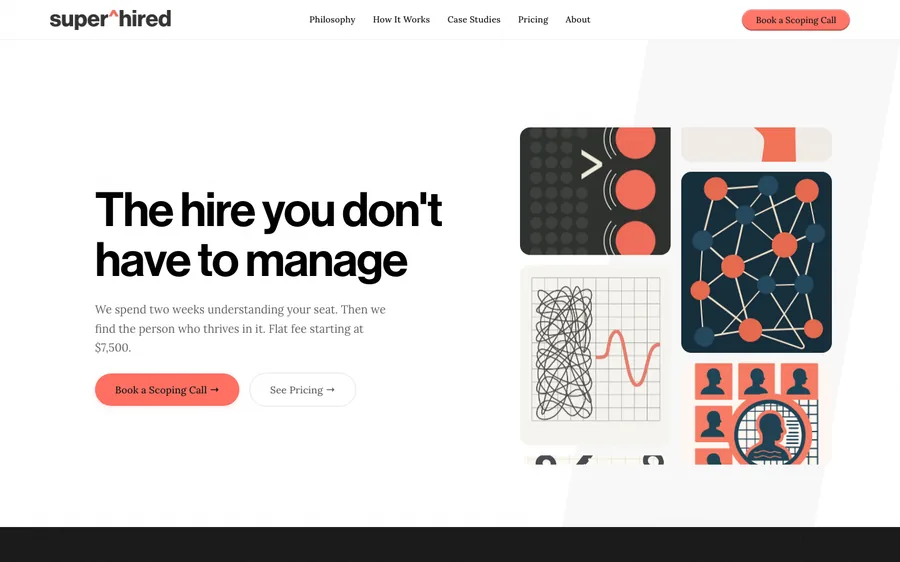
The site says one thing above the fold, and it's the thing a hiring manager actually wants to hear: the hire you don't have to manage. No rotating taglines, no seasonal voice. The first line carries the whole brand, because people don't read hiring copy twice.
Social
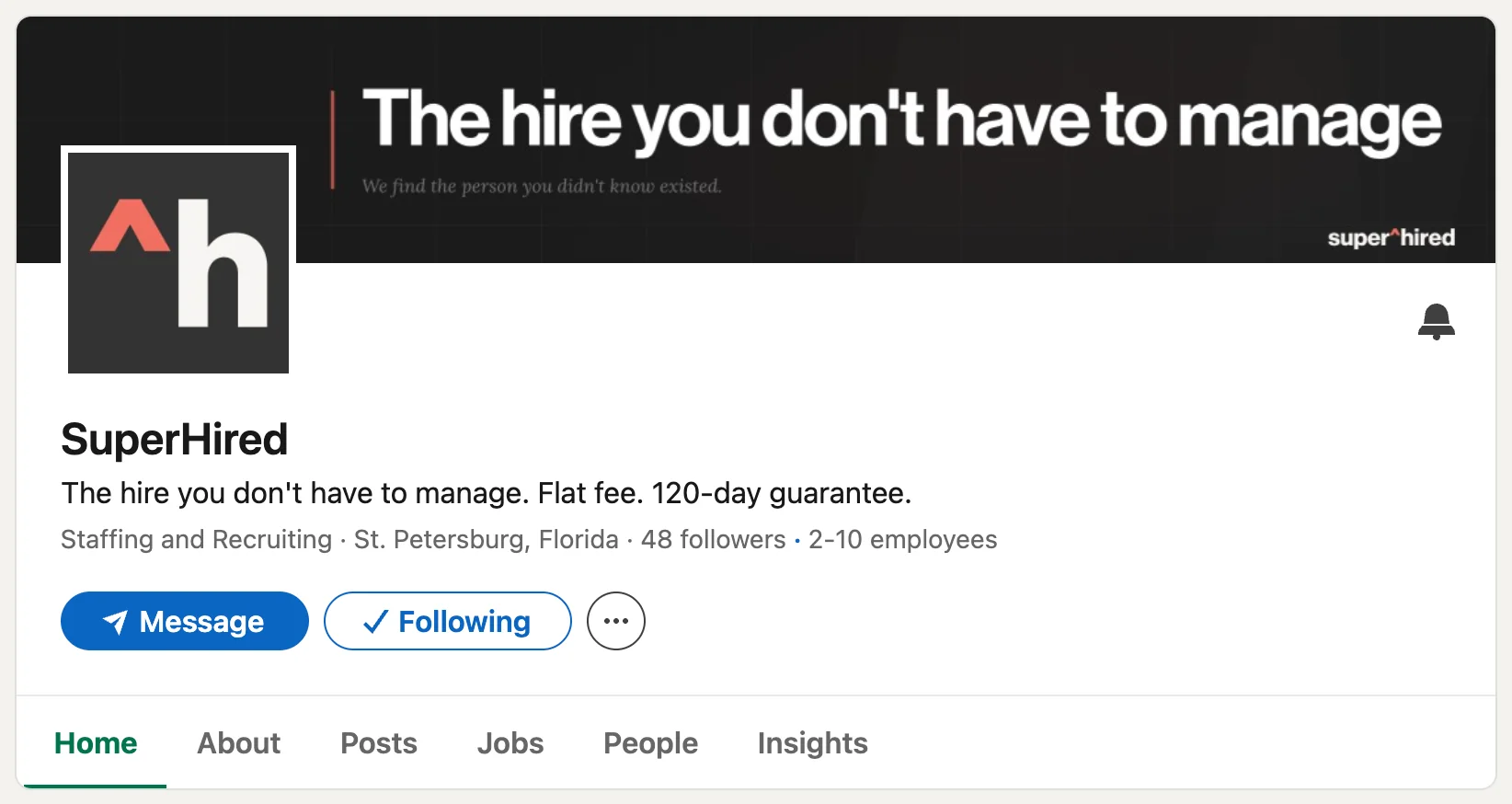
Social is where brands drift: a clever line here, a campaign voice there. SuperHired's company page repeats the same sentence the site leads with, on purpose. Familiar to a person scrolling past. Identical to a machine building a profile.
Identity

the hire you don't have to manage
identity / v1The identity board hands designers a system, not a mood: the wordmark, the coral, the char, and the one sentence the brand leads with. Every asset that ships gets cut from this board, which is why every surface above agrees.
Film
 film · in production 00:00:00:00
 film · in production · nothing to read yet
The film is being shot now. We could hang a finished-looking frame here and let you assume the rest. Instead the slate stays honest: there's nothing to read yet, for you or for a machine, and it'll appear here when there is.
the measured part
The campaign closes on a number, not a feeling.
Every campaign we build opens with a baseline run: real queries to the major AI models, cold and branded segments kept separate, every figure bound to the run that produced it. SuperHired's baseline is below, exactly as measured. The runs that follow it are published next to our own self-audit, in the same format, with the same definitions. See the full Ledger.
entry 02 · naming system
Rhumb. A name agents can hold onto.
A naming and terminology engagement for Rhumb, an agent gateway for the non-agent-native internet.
Before Rhumb could explain what it does, it needed words that survive both readers: a name a person can say out loud, and a string an agent can resolve without a footnote. So we ran the naming as an instrument, not a brainstorm. About 2,850 candidates across 12 generation waves, scored for people and machines on the same sheet, pressure-tested by 8+ expert panels. RHUMB won the final vote 37 to 1 across 39 voters.
The product pillars came out of the same system: Index, the catalog that ranks, and Resolve, the router that acts. Index ranks. Resolve routes. Two words an agent doesn't need explained.
This was naming and terminology work. No visibility numbers exist for it, so none are shown.
entry 03 · naming + brand architecture
Alien Eyes. A product family that explains itself.
A naming and brand-architecture engagement for Alien Eyes, an agent-native quality auditor.
Alien Eyes audits what you build from the one perspective you can't have: the outside. The brand problem was scale. One parent name, two products, three service tiers, all of it legible to a developer at a glance and to an agent parsing a tool catalog.
The system that came out: ALIEN EYES as the parent. Preflight and Growth Audit as the products, names that say what they do before a docs page loads. Scan, Loop, and Watch as the service tiers. Behind those seven words sit 250+ candidates, 16+ panels, and 95+ evaluators across every workstream.
Same rule as above: naming and architecture work, no visibility metrics, none invented.